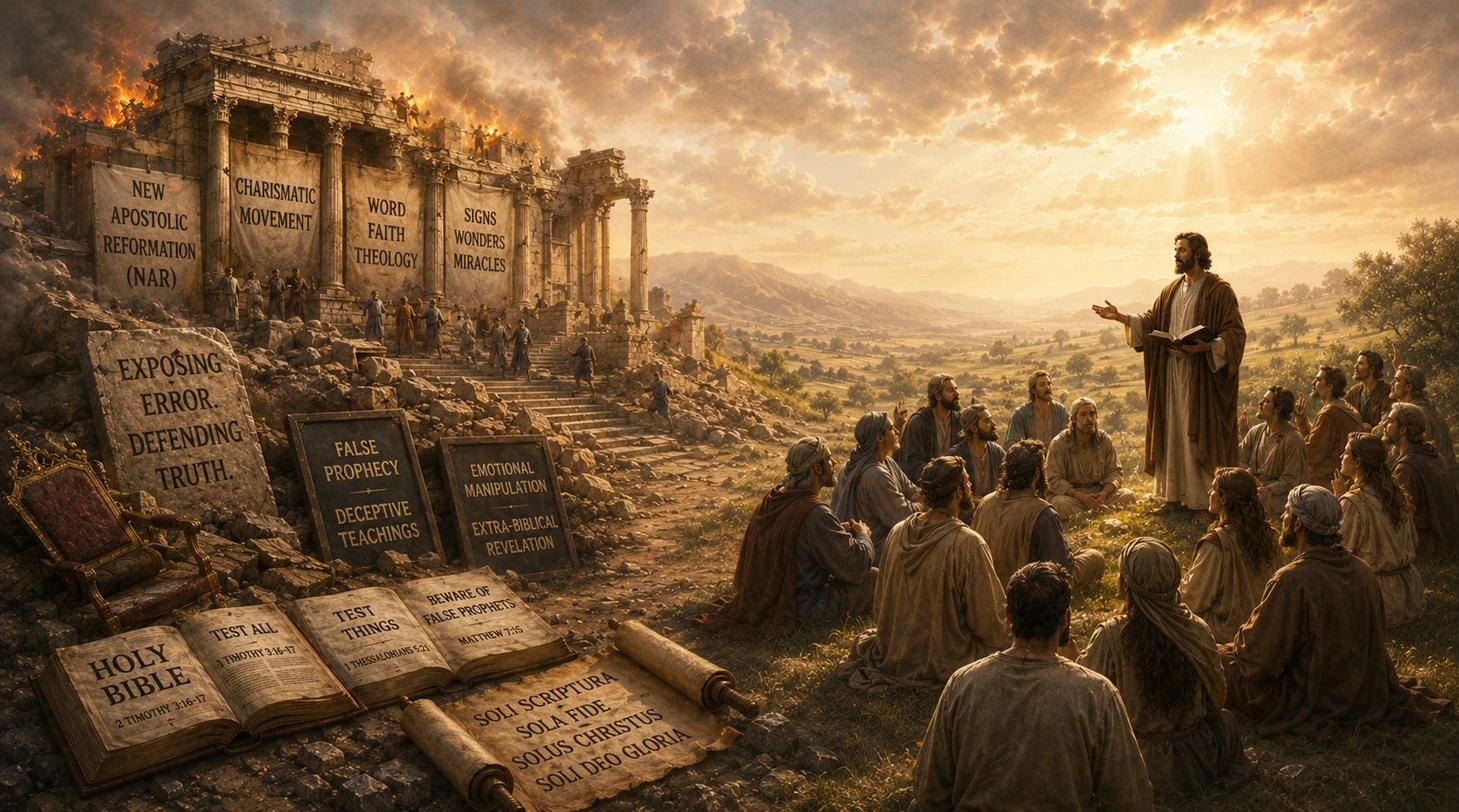
Exposing Error.
Defending Truth
Sola Scriptura
Tap to explore ›
Scripture, history and sound doctrine examined honestly.
Exposing Error.
Sola Scriptura
Tap to explore ›
Scripture, history and sound doctrine examined honestly.
A clear-eyed introduction to their origins, claims, appeal - and why they matter
The Charismatic movement and its most extreme development - the New Apostolic Reformation (NAR) - represent one of the most significant and contested theological developments in modern Christianity. Teaching that miraculous gifts never ceased, that God raises up new apostles and prophets today, and that believers can command healing, prosperity, and even political dominion, these movements have reshaped global Christianity in ways that demand careful, Scripture-grounded examination. This site provides structured, analytical critique of their core claims - examining them honestly against the biblical text, church history, and sound doctrine.
Key Articles
▣ Articles coming soon
The first foundational articles in the Charismatic Theology category are in preparation. Check back shortly.
A note on terminology. The broader movement goes by several overlapping names. Charismatic Christianity describes all streams that affirm the continuation of miraculous spiritual gifts - tongues, prophecy, healing - beyond the apostolic era. Neo-charismatic or Third Wave refers to independent charismatic churches and networks outside classical Pentecostalism and denominational charismatics. The New Apostolic Reformation (NAR) is the most structured expression of these streams - a global network of self-declared apostles and prophets claiming authority equivalent to the biblical originals. The word of faith or prosperity gospel movement teaches that health and wealth are the covenant right of believers who speak in faith. The prophetic movement emphasises personal prophecy, prophetic ministry, and direct revelation. All of these are examined on this site.
These movements have no single headquarters and no agreed confession of faith. They exist as networks of independent ministries, megachurches, Bible schools, and online communities united by shared convictions about spiritual gifts, apostolic authority, and divine imminence. The NAR in particular operates through relational covenants between apostles and those under their spiritual covering - structures that frequently produce the spiritual abuse this site documents carefully.
The modern charismatic movement has identifiable historical roots, though its proponents often prefer a more dramatic account of Spirit-outpouring disconnected from traceable cause and effect.
Classical Pentecostalism emerged from the Azusa Street Revival in Los Angeles in 1906, led by William J. Seymour. The distinctive claim - that speaking in tongues is the initial physical evidence of Spirit-baptism - spread rapidly through independent networks and eventually produced major denominations including the Assemblies of God. The charismatic renewal of the 1960s carried similar emphases into mainline Protestant and Catholic churches. By the 1980s a third wave - less concerned with tongues as the primary sign and more focused on signs, wonders, and prophetic ministry - was identified by C. Peter Wagner, who would later become the NAR's most prominent theologian and systematiser.
The NAR as a structured movement is largely Wagner's creation. He coined the term, developed its theology of restored apostles and prophets, and built the relational networks that give it coherence. Wagner taught that God is restoring the five-fold ministry of Ephesians 4 - apostles, prophets, evangelists, pastors, teachers - with apostles at the top of a new governance structure for the church. This is not a fringe claim within NAR networks. It is the foundational architecture.
The word of faith stream has separate but overlapping roots - in E.W. Kenyon's synthesis of Christian Science metaphysics with evangelical language, developed through Kenneth Hagin, and popularised globally through Kenneth and Gloria Copeland, Creflo Dollar, Joyce Meyer, and others. The prosperity gospel teaches that poverty is a curse, sickness is a failure of faith, and that positive confession of Scripture releases God's provision into the believer's circumstances.
Despite their internal diversity, several convictions appear consistently across charismatic and NAR theology.
Continuationism - the gifts have never ceased. Against cessationism (the view that miraculous gifts ended with the apostolic era), charismatics affirm that tongues, prophecy, healing, and other sign gifts continue today exactly as in Acts. The biblical case for this position, and the problems it encounters when examined carefully, is addressed extensively in this site's articles.
Restored apostles and prophets with binding authority. NAR theology teaches that the church has been operating without its God-ordained governance structure for most of its history - and that God is now restoring apostles and prophets to their rightful place. These figures claim authority to receive new revelation, declare doctrine, command spiritual territories, and require submission from those under their covering. The biblical criteria for apostleship - set out in Acts 1 and 1 Corinthians 9 - make this claim extraordinarily difficult to sustain.
Prophecy as an ongoing source of binding revelation. Personal prophecy is treated as a normal and expected dimension of Christian life. Prophets speak over individuals, churches, cities, and nations. The accountability question - what happens when prophecies fail - is addressed inconsistently at best. This site documents both the theology and the empirical record.
Health and wealth as covenant rights. The prosperity gospel teaches that financial poverty and physical sickness represent a failure of faith or an unclaimed covenant blessing. Jesus bore our sicknesses in the atonement - therefore healing is available on demand to those who believe and confess correctly. The exegetical problems with this position, particularly its reading of Isaiah 53 and the healing narratives, are addressed in detail.
Dominionism - the church must take territory. Seven Mountain Dominionism, prominent in NAR circles, teaches that Christians are called to take dominion over seven spheres of cultural influence - government, education, media, arts, business, family, and religion - in preparation for Christ's return or kingdom establishment. The biblical and historical problems with this position are significant and rarely examined honestly within the movement.
It would be a mistake to engage these movements without first acknowledging their genuine appeal. People drawn to charismatic Christianity are typically not credulous or intellectually shallow. Many are sincere believers who long for a faith that is alive, present, and powerful - who have found the Christianity around them dry, institutional, and disconnected from the God of the New Testament. The desire to see God act, to hear his voice, to pray for the sick and see them healed - these are not trivial impulses. They reflect something real in the human heart before God.
The community life of charismatic churches is often genuinely warm. The worship is frequently excellent. The emphasis on the Holy Spirit's presence corrects a genuine imbalance in much of Western Christianity. And the missionary energy of these movements has planted churches and spread the gospel in parts of the world largely untouched by other streams.
This site acknowledges all of that. What it examines carefully is what happens when genuine spiritual hunger is met with theological frameworks that cannot bear the weight placed on them - when prophecy becomes unaccountable, when apostles demand submission that belongs to God alone, when healing theology leaves the sick feeling they have failed, and when financial giving is framed as the mechanism by which God releases blessing. These are not peripheral concerns. They cause documented, serious harm to real people.
The harm these movements cause is real, recurring, and often severe.
Spiritual abuse - the use of spiritual authority to control, manipulate, and silence - is endemic in high-authoritarian charismatic and NAR structures. The doctrine of spiritual covering, which teaches that believers must submit to apostolic authority or forfeit God's protection, creates exactly the conditions in which abuse thrives. Leaving is framed as rebellion against God. Questioning leadership is treated as a spiritual problem requiring correction. This pattern appears across enough independent contexts to be structural rather than incidental.
False prophecy has proliferated without accountability. The prophetic track record of prominent NAR figures is documentable and poor. The theological responses - that prophecy is partial, that it requires interpretation, that conditions apply - are not consistently applied before the prophecy is given, and those who receive failed prophecies are often left without pastoral support or honest explanation.
The prosperity gospel extracts money from people who can least afford it, in contexts where giving is explicitly linked to receiving divine favour. The exegetical gymnastics required to sustain this teaching deform biblical literacy across entire church communities.
And the sufficiency of Scripture is consistently undermined. When apostles and prophets deliver new revelation that supplements or reframes the biblical text, the canon is functionally open. What the Spirit says through the prophet today carries weight equivalent to - or in practice exceeding - what the Spirit said through Paul. This is not a minor adjustment to Christian epistemology. It is a structural challenge to the Reformation's most fundamental principle.
This site exists to engage all of these questions with the seriousness they deserve - with respect for genuine spiritual experience, with fairness to those within the movements, and with fidelity to what Scripture actually teaches.
Beloved, do not believe every spirit, but test the spirits to see whether they are from God, for many false prophets have gone out into the world. - 1 John 4:1
Our purpose and perspective
We are a group of believers - pastors, teachers, and ordinary Christians - who have watched the charismatic and NAR movements up close and felt the weight of what they do to people.
That is where this site started. Not with an academic interest in comparative theology, but with real situations. With people who gave everything to a ministry that turned out to be built on a foundation of unaccountable prophetic claims and financial pressure. With families sitting across from us describing a loved one who had handed over savings to a prosperity preacher on the promise of a hundredfold return. With believers left stranded after a failed healing prophecy, told their lack of faith was the problem. With churches that fractured when a self-declared apostle demanded a submission the New Testament nowhere authorises.
We are not professional polemicists. We have no interest in winning arguments for the sake of it. But we do believe - and believe it on biblical grounds - that identifying and engaging doctrinal error is part of what faithful Christian ministry looks like. Paul did it. The Jerusalem Council did it. John wrote his first letter precisely because false prophets had gone out into the world and were being believed. The New Testament does not treat doctrinal vigilance as optional or as the hobby of the theologically pedantic. It treats it as an act of love toward people who are being led somewhere they should not go.
We hold to the historic Christian faith - the faith confessed by the church across centuries, continents, and denominations. We believe in the full inspiration and sufficiency of Scripture. We believe in the triune God - Father, Son, and Holy Spirit. We believe that Jesus Christ is the only Saviour, that his atoning work is complete and sufficient, and that salvation is received through faith alone, by grace alone, in Christ alone.
We believe in the ongoing ministry of the Holy Spirit. We are not cessationists in the sense of believing that God no longer heals, no longer speaks, no longer acts supernaturally in the lives of his people. What we dispute is the specific theological architecture of the charismatic and NAR movements - particularly the claim that sign gifts operate today exactly as in Acts, that God has restored apostles with binding authority equivalent to the biblical twelve, and that health and wealth are covenant entitlements accessible through correct confession.
We believe that Scripture is the final and sufficient authority for faith and practice - and that any claim to revelation, whether prophetic or apostolic, must be tested against it, not placed alongside or above it.
This site is written for the person who has a family member deep in a NAR network and doesn't know how to respond. For the pastor whose congregation is being pulled toward prosperity teaching and who needs careful, substantive resources. For the believer who has encountered prophetic ministry and finds it compelling but unsettled - who senses something is wrong but cannot yet name what it is. And for the person within these movements themselves, who we hope will find here a fair representation of what they actually believe and a serious engagement with the questions they are actually asking.
We are not interested in caricature. We are not interested in dismissal. We are interested in what Scripture says - and in making that case as clearly and honestly as we can.
Now these Jews were more noble than those in Thessalonica; they received the word with all eagerness, examining the Scriptures daily to see if these things were so. - Acts 17:11
How to evaluate prophetic and apostolic claims biblically
The New Testament does not ask believers to accept every spiritual claim at face value. It asks the opposite. Test everything. Hold fast what is good. Do not believe every spirit. Judge prophecy. These are not recommendations for the suspicious - they are commands addressed to the entire church. The charismatic and NAR movements, by their own theology, generate an enormous volume of claims requiring careful evaluation: prophetic words, apostolic declarations, healing testimonies, reports of miraculous signs, and revelatory experiences. Scripture provides the tools for that evaluation. This section exists to apply them.
Deuteronomy 18 establishes the foundational test for prophetic claims with striking clarity: if what a prophet says does not come to pass, the prophet has spoken presumptuously, the word is not from God, and the people need not fear the prophet. This is not a nuanced or conditional test. It is binary. The modern prophetic movement's standard response - that New Covenant prophecy is different, that it is partial and mixable with error, that failed predictions require charitable interpretation rather than falsification - cannot survive contact with the actual biblical text. The passages cited to soften the standard (1 Corinthians 14:29-32) are instructions about how prophecy is to function in church gatherings, not a revision of the Old Testament accuracy requirement.
The apostles of the New Testament are a clearly defined and limited group. The replacement for Judas in Acts 1 required the candidate to have been with Jesus from his baptism through the resurrection - an eyewitness of the risen Lord. Paul's apostolic credentials rest on the Damascus Road encounter - a direct, unmediated appearance of the risen Christ that he presents as unique and decisive. Nowhere does the New Testament suggest that apostolic office continues through succession, appointment by existing apostles, or claimed revelation. The NAR's architecture of restored apostles requires assumptions that the New Testament does not support and in several places directly contradicts.
Signs and wonders are not self-authenticating in Scripture. Jesus himself warns that false prophets will perform great signs and wonders sufficient to deceive, if possible, even the elect. The criterion for evaluating a supernatural claim is not whether something impressive occurred - it is whether the teaching attached to it conforms to Scripture. A healing that accompanies correct doctrine is evidence of nothing unusual. A healing that accompanies the demand for financial seed-sowing, prophetic submission, or apostolic authority is grounds for careful examination, not uncritical celebration. The articles in this category examine specific claims in the charismatic and NAR movements against these standards.
In healthy theological environments, claims can be examined and found wanting without the questioner being pathologised. In high-control charismatic contexts, scepticism about a prophecy is frequently treated as a spiritual problem - a failure of faith, a grieving of the Spirit, or evidence of a religious or Jezebel spirit that needs deliverance. This framing is not innocent. It is precisely the mechanism by which accountability is prevented. When the act of testing becomes evidence of spiritual deficiency, the New Testament command to test has been functionally overridden. Naming this dynamic clearly is one of this site's purposes.
Do not despise prophecies, but test everything; hold fast what is good. - 1 Thessalonians 5:20-21
The doctrinal foundations of biblical faith
Theology is not a cold academic discipline. It is the attempt to understand God as he has actually revealed himself - and the stakes could not be higher, because the way we understand the gospel, the Spirit, the nature of Scripture, and the structure of the church determines the shape of the entire Christian life. Get the theology right, and questions about spiritual gifts, apostolic authority, and prophetic revelation find their natural resolution. Get it wrong, and the church becomes vulnerable to structures and claims the New Testament was specifically designed to prevent.
The charismatic and NAR movements force a set of theological questions that have been debated since the apostolic era itself. This section sets out the relevant doctrinal framework clearly and honestly - not to win arguments, but because the people drawn into these movements deserve theological engagement, not dismissal.
The Reformation principle of Sola Scriptura does not mean that Scripture is the only thing that exists or that the Holy Spirit stopped speaking after the canon closed. It means that Scripture is the final, sufficient, and self-interpreting rule of faith and practice - that every claim to revelation, every apostolic declaration, every prophetic word must be tested against it and, if it conflicts, rejected. When apostles and prophets claim authority to add to, reinterpret, or supplement the biblical text through fresh revelation, the principle of sufficiency is not merely strained. It is functionally abandoned.
The Holy Spirit is not a force to be activated or a power to be seized. He is the third person of the Trinity - sovereign in his operations, irreducible to any formula or practice, given to the church in his fullness at Pentecost and resident in every believer. He convicts of sin, produces the fruit of Christ's character, illuminates Scripture, empowers witness, and intercedes in prayer. The question this site examines is not whether the Spirit works - he does, always - but whether specific theological claims about his operations conform to the scriptural account of who he is and how he acts.
The prosperity gospel's claim that physical healing and material prosperity are secured in the atonement requires a reading of Isaiah 53 and Matthew 8 that the context of those passages cannot support. Isaiah 53's language of bearing our griefs and carrying our sorrows is applied in Matthew 8:17 to Jesus's healing ministry during his earthly life - not to a general principle that all sickness is covered by the cross in the same way sin is. The theological category confusion that results from conflating physical healing with the atonement's central achievement - the forgiveness of sins and the restoration of relationship with God - produces both bad exegesis and documented pastoral harm.
The New Testament describes the church's leadership in terms of elders (overseers) and deacons - not apostles, prophets, and covering authorities. The five-fold ministry of Ephesians 4 describes gifts given for the church's building up, not an organisational hierarchy with apostles at the apex. The NAR's governance theology requires reading Ephesians 4 as an office structure - with identifiable, authoritative individuals holding each role - rather than as a description of gift distributions across the body. That reading requires assumptions the passage itself does not provide, and it generates structures with no New Testament precedent and a troubling resemblance to the authoritarian patterns Paul repeatedly warns against.
All Scripture is breathed out by God and profitable for teaching, for reproof, for correction, and for training in righteousness, that the man of God may be complete, equipped for every good work. - 2 Timothy 3:16-17
The story of the Charismatic movement and its development
You cannot evaluate the charismatic and NAR movements' claims without knowing their history. Both movements present themselves as restorations of original apostolic Christianity - the recovery of something lost after the early centuries. The historical record complicates this narrative considerably.
Classical Pentecostalism traces to identifiable moments in early twentieth-century America - a Bible school in Topeka, Kansas in 1901 under Charles Parham, and the Azusa Street Revival in Los Angeles in 1906 under William Seymour. The claim that tongues-speaking as initial evidence of Spirit-baptism represents restored apostolic practice requires explaining why this specific theological formulation is absent from two thousand years of church history. The answer Pentecostalism generally gives - that the gifts ceased through unbelief and are now being restored - is itself a historical claim that can be examined against the primary sources.
The historical record shows that unusual spiritual phenomena - including glossolalia, prophetic speech, and healing - appear at various points in church history. What the Pentecostal and charismatic movements identify as the standard, normative experience of Spirit-baptism is much harder to establish from the pre-twentieth-century record than their proponents typically acknowledge.
The New Apostolic Reformation is not an ancient movement rediscovering forgotten truth. C. Peter Wagner coined the term in 1996. The theological framework - restored apostles with governmental authority over the church, spiritual mapping of territorial spirits, seven mountain dominionism, apostolic networks replacing denominational structures - was systematised in the 1980s and 1990s. The key figures - Wagner, Bill Hamon, Chuck Pierce, Cindy Jacobs, and others - are identifiable, contemporary, and their published works are available for examination. This is not a movement recovering first-century Christianity. It is a movement inventing twenty-first-century structures and claiming first-century authority for them.
The question of whether miraculous gifts ceased at the end of the apostolic era is a legitimate theological debate within historic Christianity. Cessationism - associated with B.B. Warfield's careful exegetical work in the late nineteenth century - argues that sign gifts served a specific purpose in authenticating the apostolic message and that their purpose was fulfilled when the canon was complete. Continuationism argues that gifts continue as long as the church needs them, which is to say until Christ returns. Both positions have serious exegetical defenders and serious exegetical problems. This site takes continuationism seriously while examining the specific claims the charismatic and NAR movements build on it.
See to it that no one takes you captive by philosophy and empty deceit, according to human tradition, according to the elemental spirits of the world, and not according to Christ. - Colossians 2:8
Living as a disciple in the modern world
The charismatic movement, at its best, is a movement about the lived reality of faith - about a God who is present, active, and intimately concerned with the lives of his people. That instinct is not wrong. The New Testament does describe a God who heals, who speaks, who acts in power. The question is not whether these things are true - it is whether the specific theological frameworks the charismatic and NAR movements have built around them are faithful to Scripture and healthy for the people who inhabit them.
One of the consistent patterns across charismatic theology is the movement from experience to doctrine rather than from doctrine to experience. A phenomenon occurs - an unusual physical sensation, a vision, a sense of prophetic impression - and theological categories are then constructed to explain and validate it. This inversion of the proper relationship between Scripture and experience is not a minor methodological concern. It generates an epistemological environment in which almost anything can be theologically justified if it is accompanied by sufficient intensity of experience.
Scripture does not treat subjective experience as self-validating. The Bereans who tested Paul's teaching against the written word are commended, not corrected. The criterion for evaluating spiritual claims is always and first the conformity of the claim to what God has already spoken in Scripture - not the intensity, sincerity, or emotional power of the experience accompanying it.
The charismatic movement's theology of healing creates a pastoral problem that is serious, recurring, and rarely addressed honestly. If healing is available on demand to all who believe correctly, then the person who is not healed has, by definition, not believed correctly. The guilt and shame this places on sick believers - people already carrying the weight of illness - is documented in the testimonies of those who have left these movements. It is not a peripheral concern. It is the direct consequence of a theological claim that cannot be sustained from the text.
The New Testament record of healing is not uniform. Paul left Trophimus sick at Miletus. Timothy was advised to take wine for his stomach problems rather than commanded to confess healing. Paul's thorn in the flesh - whatever it was - was not removed despite repeated prayer. These are not embarrassing anomalies to be explained away. They are part of the apostolic witness and they have something important to say about the theology of healing that the movement consistently fails to hear.
Perhaps no area of charismatic theology produces more documented financial harm than the prosperity gospel's theology of giving. Seed-faith giving - the teaching that financial gifts to the ministry, made in faith, release a supernatural multiplication of return - extracts money from vulnerable people in exchange for a promised divine response that the theology itself makes unfalsifiable. When the return does not materialise, the explanation is always located in the giver's faith rather than the theology's validity. This is not an accidental feature of the system. It is its operating logic.
But I am afraid that as the serpent deceived Eve by his cunning, your thoughts will be led astray from a sincere and pure devotion to Christ. - 2 Corinthians 11:3
The good news at the heart of the Christian faith
The word gospel means announced news - news that has already happened, that is complete, that carries its own weight regardless of what we do with it. It is not a programme or a spiritual technology. It is a proclamation. And the specific content of that proclamation - what actually happened, who did it, and what it accomplished - is the foundation that every other article on this site is trying to protect.
When the gospel is clear, questions about gifts and experience and authority find their natural resolution. When it becomes blurred - when the finished work of Christ is supplemented with prosperity promises, when Spirit-baptism becomes a second definitive experience that divides Christians into tiers, when the apostle's declaration carries weight alongside or above the biblical text - everything downstream shifts. The articles in this section exist to hold the line.
The gospel is the good news that God, in his love and mercy, sent his Son Jesus Christ to save sinners by grace, through his finished work on the cross, so that all who believe in him may receive forgiveness, new life, and eternal fellowship with God.
Scripture states this clearly: For God so loved the world that He gave His only begotten Son, that whoever believes in Him should not perish but have everlasting life. (John 3:16)
It begins with a sobering truth - all have sinned - and immediately follows with a glorious one: being justified freely by His grace through the redemption that is in Christ Jesus. (Romans 3:24)
The centre of the gospel is the finished work of Jesus Christ. At the cross, he took upon himself the sin of the world: For He made Him who knew no sin to be sin for us, that we might become the righteousness of God in Him. (2 Corinthians 5:21)
His sacrifice was not provisional or ongoing - it was once for all: For by one offering He has perfected forever those who are being sanctified. (Hebrews 10:14) Because of this finished work, there is no further offering required, no further achievement needed, no further level to reach: There is therefore now no condemnation to those who are in Christ Jesus. (Romans 8:1)
The prosperity gospel does not deny Christ. It supplements him. And in that supplementation, it fundamentally reframes what the gospel is for. When the primary benefit of faith becomes health and wealth in this life - when the cross is the mechanism by which poverty is redeemed and sickness is healed - the gospel ceases to be news about what God has done for sinners and becomes a programme for what God will do for the believing, the giving, and the confessing. Paul anticipated exactly this kind of displacement and addressed it with language startling in its intensity. A different gospel is no gospel at all - and those who preach it, whatever their apparent anointing, are under a curse.
The gospel rests entirely on what God has done, received through faith alone. The charismatic movement's tiered spirituality - in which the Spirit-baptised believer who speaks in tongues occupies a higher level of spiritual experience than the one who does not - introduces a performance dynamic that the New Testament consistently refuses. Every believer has received the Spirit. Every believer is in Christ. Every believer stands before God on the same ground - the finished righteousness of Jesus - and that ground admits no hierarchy of experience, confession, or gifting.
That is not a small point. It is the whole point. And it is the point this site returns to, again and again, because it is the point the movements examined here consistently, if not always intentionally, obscure.
It is finished. - John 19:30